

When a natural gas storage developer opens a new capacity offering and watches it get snapped up nearly six times over, that’s not a subtle market signal. That’s what happened with Caliche Development Partners’ Spindletop expansion on the Texas Gulf Coast, and it’s a clear read on how strained regional gas storage and LNG tank capacity has become as export demand keeps climbing.
Caliche has approved the first phase of an expansion to its Golden Triangle Storage complex, and the numbers involved show both the scale of the buildout and the urgency behind it.
The scale of the Golden Triangle expansion
The first phase involves two new salt-dome storage caverns, associated surface facilities, and pipeline interconnections tying into Kinder Morgan’s Trident Pipeline and ARM Energy’s Mustang Pipeline. At full buildout, Golden Triangle will feature eight storage caverns with more than 60 billion cubic feet of working gas capacity.
The operational specs are substantial too. The facility will inject up to 2.2 billion cubic feet per day and withdraw up to 2.5 billion cubic feet per day once complete. Storage caverns three and four are expected to enter service in 2027, with expanded operations phasing in from late 2028 into early 2029.
Demand outpacing supply by a wide margin
The clearest signal of how tight the market has become came from the open season Caliche ran before committing to construction. That open season was nearly six times oversubscribed, a level of demand well beyond routine market interest, and a signal of a genuine capacity shortage among Gulf Coast gas shippers and end users.
The drivers aren’t mysterious. Increasing LNG export volumes, growing power demand, electrification trends, and rising data center energy requirements are all pulling on the same regional infrastructure at once, and storage capacity, the buffer that lets the system absorb demand swings without price spikes, hasn’t kept pace with any of those trends individually, let alone all of them together.
What this means for storage infrastructure broadly
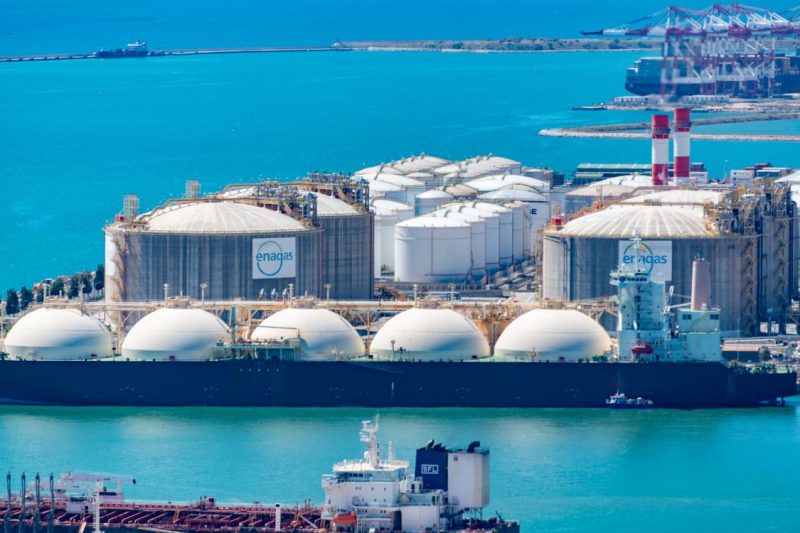
Underground salt-cavern storage and above-ground LNG tank storage serve overlapping but distinct roles. Salt caverns suit large-scale, longer-duration balancing, exactly what Golden Triangle is built to provide. Above-ground cryogenic tanks fill a different niche: compact-footprint, faster-response storage for sites where plot space is constrained or where liquefied rather than gaseous storage is the requirement, like peak-shaving stations or receiving terminals.
Both types face the same underlying demand growth. A brownfield facility expanding storage to keep pace with export terminal throughput faces a similar calculus to Caliche’s oversubscribed open season: existing capacity was sized for a demand curve that’s since been blown past, and catching up takes years, not months.
For operators and developers watching numbers like this open season result, the takeaway is less about any single project than the trendline. Gulf Coast gas and LNG infrastructure is being built about as fast as financing, permitting, and construction timelines allow, and by most signals right now, that pace still isn’t fast enough.
What’s actually slowing the buildout isn’t a lack of demand or willing developers. Caliche’s own open season result makes clear the market would happily absorb far more storage capacity than is currently being built. The constraint sits on the supply side: how quickly caverns get leached and commissioned, how quickly interconnecting pipelines get permitted and built, how quickly capital gets committed against multi-year timelines with regulatory approval steps at nearly every stage.
Salt-cavern development has a physical timeline that doesn’t compress easily. Leaching a cavern to the necessary volume and geometry takes years regardless of capital or urgency, which is part of why Caliche’s own timeline stretches caverns three and four into 2027 service and pushes full expanded operations into 2028 and 2029 even with strong backing and confirmed demand already in hand.
Caliche isn’t operating alone here. Multiple developers are pursuing salt-cavern and above-ground storage projects across the Gulf Coast simultaneously, drawn by the same demand signals. That’s created a competitive dynamic where storage developers race not just against demand growth but against each other for pipeline interconnection capacity and long-term offtake commitments. For above-ground tank projects specifically, that pressure has translated into tighter timelines and more scrutiny on design choices affecting both construction speed and long-term reliability, insulation performance, boil-off gas recovery, containment design that meets safety-distance requirements without eating more plot area than a site has available.
Financing structures have shifted alongside the physical buildout. Long-term offtake agreements, the kind Caliche’s oversubscribed open season produced, have become close to a prerequisite for lenders to commit capital to a project this size, since the multi-year construction timeline leaves a lot of room for demand assumptions to change before the first molecule of gas moves through the finished facility. Developers without that kind of committed demand locked in ahead of construction are finding it harder to get projects financed at all, regardless of how strong the underlying regional need looks on paper. That’s a real bottleneck of its own, separate from the physical construction constraints already slowing the buildout.
Interconnection with existing pipeline infrastructure has become its own source of delay. A new storage facility is only as useful as the pipeline capacity available to move gas in and out of it, and several Gulf Coast projects have run into queuing issues with interconnecting pipeline operators who are themselves managing a backlog of connection requests from multiple storage and export projects trying to come online around the same window. That queue has turned into a scheduling problem almost as consequential as the physical construction timeline itself.